
Lawn Care Marketing: The Definitive Guide
The complete lawn care marketing playbook — positioning, seasonal SEO, Google Business Profile, Local Services Ads, program pricing, reviews, referrals, email retention, and the KPIs that separate the good year from the great one.
By Justen Ward, Owner and Co-Founder, I&J Agency — a founder-led landscaping growth agency helping route-based service companies grow monthly recurring revenue.
Why lawn care marketing is its own discipline
Lawn care and landscaping look similar from the curb, but they run on completely different economics. A landscaping company sells projects — expensive, one-time installs with long sales cycles. A lawn care company sells routes — recurring visits with tight margins where the winner is whoever fills their weekly schedule first.
Because of that, generic landscaping marketing advice consistently underperforms for lawn care operators. Route density, seasonal timing, recurring program design, Google Business Profile freshness, and same-day review requests matter far more than a redesigned logo or another Instagram post.
This is the definitive guide we run internally with every lawn care client. It pairs with our Landscaping SEO Checklist and the full landscaping SEO keyword map — read this first for the strategy, then use those two for the execution.
Positioning: sell the route, not the mow
Every profitable lawn care operator we work with sells a program, not a service. The homepage, the pricing page, and even the Google Business Profile description should reinforce the same idea — you take the lawn off the homeowner's list for the entire season. One-off mows are how you burn a Saturday; recurring maintenance contracts are how you build a company.
- Lead with the outcome ("a lawn you never have to think about") before the deliverables (mow, edge, blow, fertilize).
- Name your program. "The Signature Lawn Program" converts better than "Weekly Mowing Package" because it feels branded, not commoditized.
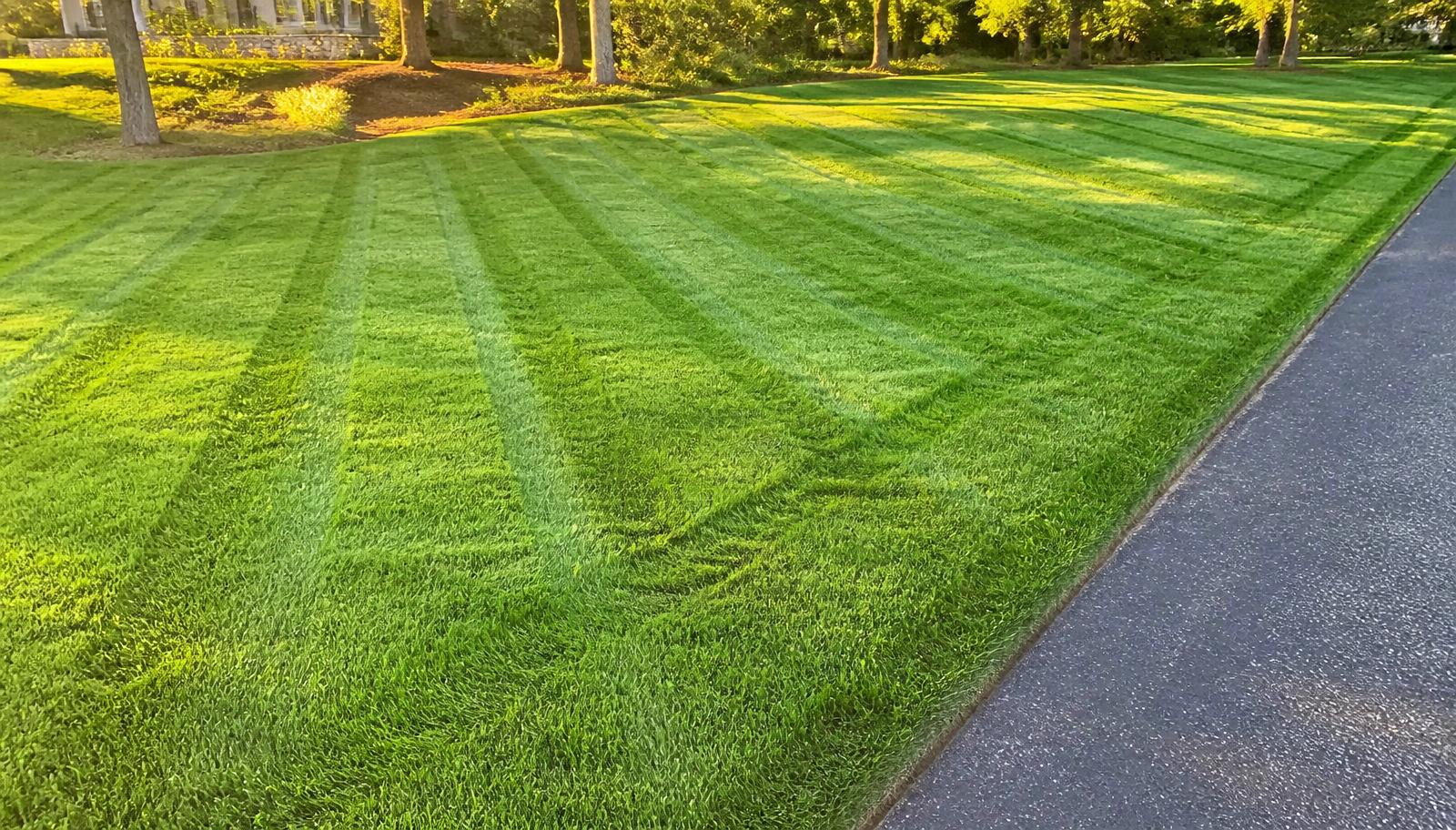
- Reserve one hero image for a manicured, striped, dark-green lawn — that's the transformation you're selling.
- Segment your audience: residential recurring, HOA / property management, and light commercial each need their own landing page and their own proof.
- Kill the "Get a Free Quote" button as your only CTA. Add a secondary "See Program Pricing" CTA — it filters out tire-kickers before they eat 20 minutes of your day.
Seasonal scheduling that fills your calendar
Lawn care is not a one-off purchase like a patio install — the entire business depends on stacking recurring visits into tight, profitable routes. Your marketing has to match the season the customer is thinking about, not the season you're trying to sell.
- Publish a spring cleanup landing page by mid-February — searches for 'spring lawn cleanup near me' start climbing weeks before the first mow.
- Run a fall aeration and overseeding page from mid-July with early-bird pricing to lock in September and October dates.
- Add a leaf removal page in early September so it's already indexed when the first freeze hits.
- Create a winterization and snow removal page in October — even if you only do a handful of jobs, it captures brand searches for later.
- Rewrite the homepage hero image and CTA every quarter to reflect the current season's primary service.
- For warm-season markets (Bermuda, Zoysia, St. Augustine), shift the calendar six weeks later than the cool-season plan below — the search intent tracks the mowing season, not the calendar year.
Recurring service promotion (the real profit lever)
One-time mow customers are exhausting. Weekly, bi-weekly, and full-program contracts are how lawn care businesses stop trading time for money. Your marketing should push people toward the recurring plan, not the single visit.
- Design one clear 'Lawn Care Program' page with monthly pricing tiers — Basic (mowing), Plus (mow + fertilizer), Premium (mow + fertilizer + weed + aeration + grub control).
- Anchor pricing so the middle tier looks obvious. Most homeowners will pick it if it's framed as the 'most popular' plan.
- Show the annual savings vs. calling for one-off visits — real dollar amounts, not vague 'save money' claims.
- Include a photo timeline of a real customer's lawn from April to October to prove the compounding results.
- Add a simple opt-out clause up front (cancel anytime after the first visit) — reduces the friction that kills sign-ups.
- Follow every quote with a text and email in the first 48 hours; recurring-plan conversions drop by more than half after day three.
- Bill monthly at a flat rate rather than per-visit — smoother cash flow and homeowners perceive it as a subscription, not a variable bill.
Local SEO built around your routes
Lawn care margins live and die on drive time. Marketing that pulls in leads from towns you already service is worth two or three times more than leads on the edge of your territory. Every SEO decision should reinforce the routes you actually want to grow.
- Build one city page per primary service area (e.g. 'Lawn care Greenwood, IN'). Not with the city name swapped in — real content: neighborhoods, HOAs, common grass types, drive-time notes.
- Add LocalBusiness + Service schema markup to every service and city page so Google shows your hours, phone, and area served in rich results.
- List your business under one primary Google Business Profile category — 'Lawn care service' — and use secondary categories for aeration, snow removal, etc.
- Ask for a Google review after every third visit for recurring customers; volume is what moves the local pack.
- Get one backlink per service area — the local Chamber of Commerce, the HOA newsletter, or a neighborhood Facebook group post.
- Use consistent NAP (name, address, phone) across GBP, Yelp, BBB, Nextdoor, Angi, and your website footer — inconsistencies quietly cap your local rankings.
Google Business Profile: the highest-ROI hour of your week
For local lawn care companies, GBP outperforms the website itself for phone calls and direction requests. Treat it like a living asset — not a one-time setup.
- Fill every field. Services, service areas, attributes, hours, holiday hours, opening date, and appointment link all feed the ranking algorithm.
- Upload 3–5 new photos every week. Freshness signals matter, and dated photos of real jobs beat stock imagery every time.
- Post a weekly GBP update — seasonal offer, before/after, or a tip. Posts expire after 7 days, which is why weekly frequency matters.
- Turn on Messaging and respond in under an hour during business hours — response speed is a documented ranking factor.
- Enable the Products section for each program tier with real pricing; it doubles as a mini pricing page inside search results.
- Answer every review, positive and negative, within 48 hours using the customer's first name and one specific detail from the job.
Paid ads that actually pay back
Ads are a supplement, not a replacement, for local SEO. Used well, they smooth cash flow in the shoulder seasons and defend your brand from competitors bidding on your name. Used poorly, they burn a large share of your marketing budget on tire-kickers.
- Start with Google Local Services Ads (LSA) — you only pay per qualified lead, you rank above the map pack, and the Google Guaranteed badge lifts trust.
- Run a small branded search campaign ($5–15/day) so competitors can't outbid you on your own company name.
- Layer in a service-specific Search campaign for high-margin services (aeration, sod, grub control) during their booking window only.
- Skip Facebook lead-form ads for lawn care — the leads convert at half the rate of organic and require a full drip campaign to close.
- Retargeting on Meta works only after 500+ monthly site visitors; below that, budget goes further into local SEO.
- Track every ad lead in a spreadsheet or CRM with source, quote value, and won/lost — most operators never calculate real cost-per-booked-job and overspend for years.
The review + referral engine
Reviews are the single largest lever on your local pack ranking and your quote-to-close rate. Referrals are the cheapest customer you'll ever acquire. Both need a system, not a hope.
- Send a review request text a couple of hours after the visit — not the next day. Same-day requests typically get answered far more often.
- Use a short URL that goes straight to your Google review page (g.page/r/... link). Every extra tap loses a share of the customers who intended to leave a review.
- Rotate the ask between crew leads and the owner — a personal request from the person who did the work outperforms a generic automation.
- Offer $25 account credit for every referred neighbor who signs up for a program. Neighbors have the same grass, the same HOA, and the same drive time — pure margin.
- Print a small yard sign the week after install/first cleanup: "Lawn care by [Company Name] — 555-1234". Cheap, and it earns 1–2 route neighbors per season.
- Feature named customer reviews on your service and city pages with the reviewer's town — it doubles as EEAT and local relevance signal.
Email and SMS retention
Winning a new customer almost always costs more than keeping one. A quiet email and SMS rhythm is the difference between a company that grows and one that just replaces churn.
- Send a monthly seasonal tip email — never a pitch. Trust compounds; the pitch happens twice a year (spring renewal, fall upsell).
- Text a 24-hour heads-up before every visit. Cuts cancellations, lets homeowners move dog toys, and quietly reinforces reliability.
- Automate a "90-day check-in" email to every new customer asking one open question. Every response is future testimonial fuel.
- Segment past customers into "lapsed under 12 months" and "lapsed 12+ months" — the two lists need different offers and different tone.
- Send a winter thank-you card (physical, not email) to your top customers. The cost per card is small, and physical mail stands out in a channel your competitors have abandoned.
The keywords that actually book jobs
Broad landscaping keywords are noisy and expensive to compete for. Lawn-care-specific searches are usually narrower, easier to rank for, and carry clearer commercial intent. These are the phrases to build pages around — see our full breakdown in the landscaping SEO keywords map.
- lawn care marketing
- lawn care services near me
- weekly lawn mowing service [your city]
- lawn fertilization program
- lawn aeration and overseeding
- lawn care company [your city]
- affordable lawn care near me
- commercial lawn care [your city]
- grub control service
- spring lawn cleanup near me
- fall lawn cleanup [your city]
- lawn care cost per month
- best lawn care service [your city]
Content that ranks and content that converts
Ranking content and converting content are different jobs. Most lawn care sites publish blog posts that rank for informational queries but never turn into booked jobs. The fix is two content tracks running in parallel.
- Ranking content: seasonal how-tos ("When to aerate a lawn in [state]", "How much does lawn care cost in [city]?") — top-of-funnel, cast a wide net.
- Converting content: service pages, city pages, and program pages with clear pricing, real photos, and a single primary CTA.
- Internal-link every ranking post to at least one converting page using descriptive anchor text ("our lawn care program in Greenwood", not "click here").
- Add a table of contents to every long guide — it helps readers reach the section they came for, and can surface as jump links in search results.
- Refresh top-performing posts every 12 months. Google rewards updates; competitors won't bother.
- Publish one video walkthrough per program tier. Embedded on the pricing page, video helps hesitant buyers picture the service before they call.
Website conversion basics that most operators skip
You can rank at the top and still lose the job in the last 30 seconds. These are the on-site fixes that turn ranking into booked revenue.
- Click-to-call phone number in the header on mobile — no dropdown, no menu, one tap.
- Instant quote form under 5 fields (name, address, phone, service, notes). Every extra field costs you completions — ask for the rest on the phone.
- Live pricing ("Programs from $XX/month") on the homepage above the fold — hiding pricing kills trust with modern homeowners.
- Trust bar with insurance, years in business, review count and star rating in the first viewport.
- Load in under 2.5 seconds on 4G mobile. Slower loads consistently cost mobile conversions.
- Match the phone number, business name, and address in the footer exactly to your Google Business Profile.
KPIs that separate the good year from the great year
If you can't name these numbers off the top of your head, marketing is a hobby. Track them monthly.
- Cost per booked job (not per lead) — total marketing spend / new signed contracts.
- Program mix — share of revenue from recurring programs vs. one-off work. The higher the recurring share, the more predictable your season becomes.
- Route density — average revenue per mile driven. Every marketing decision should push this up.
- Google Business Profile actions (calls + direction requests + website clicks) — trending up month-over-month is the leading indicator.
- Organic traffic to city pages — the earliest sign local SEO is compounding.
- Reviews per 30 days — target ≥8 for growth, ≥4 to maintain.
- Customer lifetime value — average program price × average retention in months. Should climb every year.
A 12-month lawn care marketing plan
Marketing works when it is boring and predictable. Here is the rhythm we run for cool-season markets (Kentucky bluegrass, tall fescue, perennial ryegrass) — same actions every year, adjusted for the local climate. For warm-season grasses (Bermuda, Zoysia, St. Augustine, Centipede), shift each item 4–6 weeks later.
- 01January — audit last year's routes, publish the annual pricing update, launch the spring cleanup landing page.
- 02February — email past customers with early-bird program pricing; refresh Google Business Profile photos; open Local Services Ads applications.
- 03March — first mow of the season; ask every happy customer for a Google review that week; ramp branded search ads.
- 04April–May — push recurring plan sign-ups on the homepage hero; publish weekly lawn-care tip posts; enable LSA at full budget.
- 05June–July — publish the fall aeration and overseeding page; run a mid-season program upsell to Basic-tier customers.
- 06August — sponsor one local event or HOA newsletter to earn a real local backlink; audit reviews and respond to every one.
- 07September — activate leaf removal page; email fall cleanup offer to every past summer customer; refresh city pages.
- 08October–November — winterization and snow removal pages live; collect final review requests before the season ends; wind LSA budget down.
- 09December — send a year-end thank-you email plus a physical card to top 20% customers with next season's early-bird lock-in.
Common questions about lawn care marketing
How is lawn care marketing different from general landscaping marketing?
Landscaping projects are one-time, high-ticket purchases — patios, walls, full designs. Lawn care is recurring, route-based, and season-driven. The marketing has to sell a program instead of a project, and it has to publish seasonal content weeks before the customer starts searching.
What is the best lawn care marketing channel for a new company?
Local SEO — a fast website, a fully complete Google Business Profile, steady Google reviews, and one page per service area — outperforms paid ads for the first 12 months in almost every market. Google Local Services Ads (LSA) are the right supplement in month three or four once your GBP is warm and you have the review count to compete.
How much should a lawn care business spend on marketing?
Marketing budgets are usually set as a percentage of revenue, and newer companies generally need a higher percentage than established ones with a stable base of recurring customers. Whatever number you land on, front-load the spend in January and February so the site is ranking and the GBP is warm before the spring rush.
How long does it take for lawn care SEO to bring in leads?
Local lawn care keywords are less competitive than general landscaping terms. A technically clean site with a complete GBP and consistent reviews usually starts showing movement in 6–10 weeks and produces steady lead flow by month four.
Are Google Local Services Ads worth it for lawn care?
Yes, once you have 15+ Google reviews and can respond to lead notifications within an hour. LSA charges per qualified lead (not per click), places you above the map pack, and awards the Google Guaranteed badge — a documented trust signal. Below 15 reviews, invest in the GBP first; leads that do come in will convert poorly without social proof.
How many Google reviews does a lawn care company actually need?
Aim for 25 reviews to be competitive in the local pack, 75 to lead most suburban markets, and 150+ to dominate a metro. Volume and freshness both matter — five reviews in the last 30 days outweigh fifty from two years ago.
Should I put pricing on my lawn care website?
Yes — at least starting prices per program tier. Hiding pricing filters out serious buyers who assume the worst, and it kills the trust homeowners now expect from any subscription-style service. Show pricing, then let the quote form fine-tune it.
Which lawn care services are the highest-margin to market?
Fertilization programs, aeration and overseeding, grub control, and mosquito treatments all beat straight mowing on margin per hour on-site. Build a dedicated landing page for each, publish it 6–8 weeks before its booking season, and upsell existing recurring customers first — they close far more readily than cold leads because the trust already exists.
Do I need a separate website for lawn care if I already have a landscaping site?
Usually no. A single domain with a well-structured Lawn Care section (homepage link, program page, service pages, city pages) beats a second domain on SEO and on operating overhead. Build a second site only when the two brands genuinely serve different markets (e.g. commercial-only vs. residential-only).
How do I get lawn care referrals without asking awkwardly?
Systemize it: a $25 account credit for every referred neighbor who signs a program, a small yard sign after first cleanup, and a printed door-hanger with the referring customer's first name given to the crew for the two houses on either side. All three run without you saying a word.
About the author
Justen Ward is the Owner and Co-Founder of I&J Agency, a founder-led landscaping growth agency based in Whiteland, Indiana. He works directly with lawn care and landscaping companies across the U.S. on the exact playbook above — websites, local SEO, and program-based lead generation designed for route economics.
Want the printable lawn care marketing plan?
Grab the free seasonal calendar we use with lawn care and landscaping clients — every action, every month.
- Technical SEO and Core Web Vitals
- Google Business Profile signals
- Conversion and lead-capture paths
- One prioritized next best action